




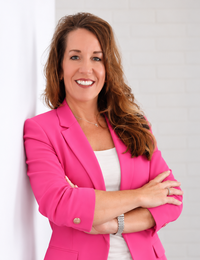
Amy Collins
Amy Collins
My story is one of hope, faith, and encouragement. I received my first mammogram at the age of 35. At that time, I learned that I had dense breast tissue. Because of this, there were several occasions over the years when I was called back for additional imaging. Each time, thankfully, the results were negative—until June 16, 2023.
This time, the follow-up mammogram revealed something suspicious, and a biopsy was needed. At first, I wasn’t overly concerned. I had recently had bloodwork done, and all my numbers—including my red and white blood cell counts—looked great. I felt healthy, and I had no family history of breast cancer.
Then, on the morning of June 22, 2023, I received a call from my doctor’s oƯice. “The doctor would like to see you to review your biopsy results.”
I asked when she wanted me to come in.
“Can you come this afternoon at 2:30?”
My heart sank, and a huge lump formed in my throat. I agreed to the appointment and immediately called my husband to ask him to go with me. Somehow, I already knew it wasn’t going to be good news.
My husband and I arrived for the appointment and were taken back to an exam room to wait for the doctor. I will never forget the moment she walked through the door. As soon as I saw her face, I knew.
She said, “I’m so glad you brought your husband with you. I don’t have good news.”
Everything around me suddenly felt silent and dark.
How could this be? How could I have breast cancer? I had no family history. I felt healthy.
This had to be a dream.
From that moment forward, my faith in God carried me.
The biopsy confirmed that I had invasive ductal carcinoma. I was immediately referred to my surgeons and scheduled for an MRI. Further testing showed that the cancer was estrogen- and progesterone-receptor positive and HER2-negative. It was Stage 1.
I also underwent genetic testing. No harmful variants were identified among the 47 genes tested, including BRCA1 and BRCA2. Although I was grateful for those results, they reinforced something important: breast cancer can still happen even without a family history or an identified hereditary risk.
The days turned into weeks, and the weeks felt like months. No one outside of my husband seemed to feel the same sense of urgency that I did. I wanted the cancer out of my body as soon as possible, but I had to wait until August for surgery. It felt like an eternity.
I chose to undergo a double mastectomy with reconstructive surgery. The day finally came on August 14, 2023. I knew my body, as I had always known it, would never be the same—but I also knew I was doing what I believed gave me the best opportunity to move forward.
Then came another diƯicult period of waiting: waiting for the pathology results.
Thankfully, the results showed clear margins and no evidence of cancer in the four lymph nodes that were tested. I was overwhelmed with relief. Because the cancer had been detected early, I did not need chemotherapy or radiation. My continuing treatment would be a long-term oral anti-cancer medication called anastrozole, a form of hormone therapy that helps reduce the risk of the cancer returning.
My experience is shared by far too many women, each with her own story, her own fears, and her own battle. But I share mine because I want other women to know that a breast cancer diagnosis is not automatically a death sentence. There is hope.
Early detection matters. Please go for your yearly mammograms, even when they are uncomfortable, inconvenient, or frightening. Know whether you have dense breast tissue, and talk with your doctor about whether additional screening may be appropriate for you.
Pay attention to your body, keep your appointments, ask questions, and never be afraid to advocate for yourself.
Cancer can be present even when you feel healthy, your bloodwork looks normal, you have no family history, and genetic testing does not identify a hereditary risk. I am living proof that routine screening can find something before you ever know it is there.
I do not know how I would have made it through those darkest moments without my faith in God and the tremendous love and support of my husband, who stood beside me at every appointment and through everything that followed. Find your support system—whether it is your spouse, a family member, a friend, your church, or someone who has walked this road before you. You do not have to face it alone.
My scars are a reminder that I was stronger than something that was meant to kill me.
Breast cancer changed my body and changed my life, but it did not take away my faith, my purpose, or my hope.
Today, I stand not only as a breast cancer survivor, but as a reminder that early detection saves lives, support gives us strength, and even in the most frightening moments, there is still hope.